Curioscillotropy
Meaning: "To follow the oscillations of thought". Derived from the words; "Curious", "Oscillate", and the suffix; "Tropy".
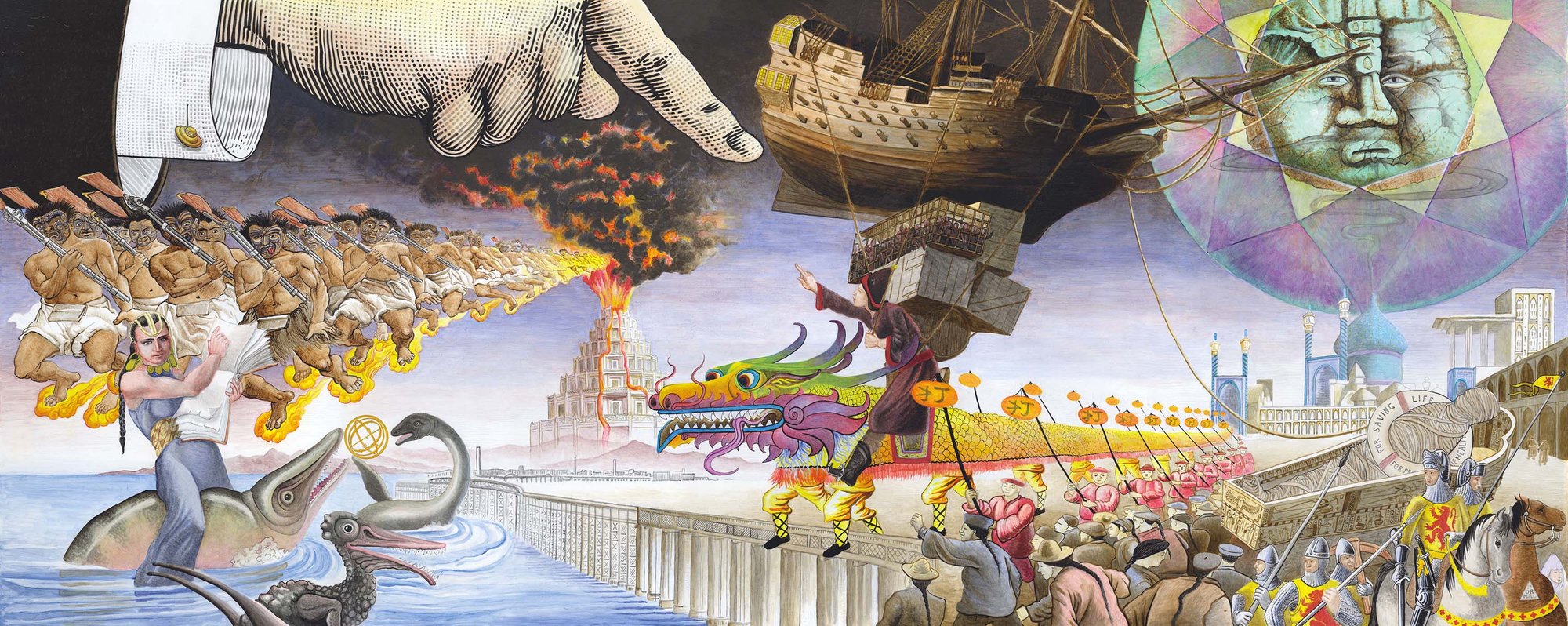
Curioscillotropy, of all the 4 Crossroads paintings, is the one that refers most clearly to the theme of 'Caravansary' (from Burning Man 2014). The painting is a Rube Goldberg like machine that plays with history. It shows the Mongols being expelled from China, the galleon trade ships opening a passage to the East, Crusades as the foundation of European cultural imperialism, and Maori's erupting forth apocalyptically to reap an atavistic revenge. All these things are here - and more displayed in the playful free associative manner that runs through all of the pieces.
Curioscillotropy
(7)
Patagonian Dancer
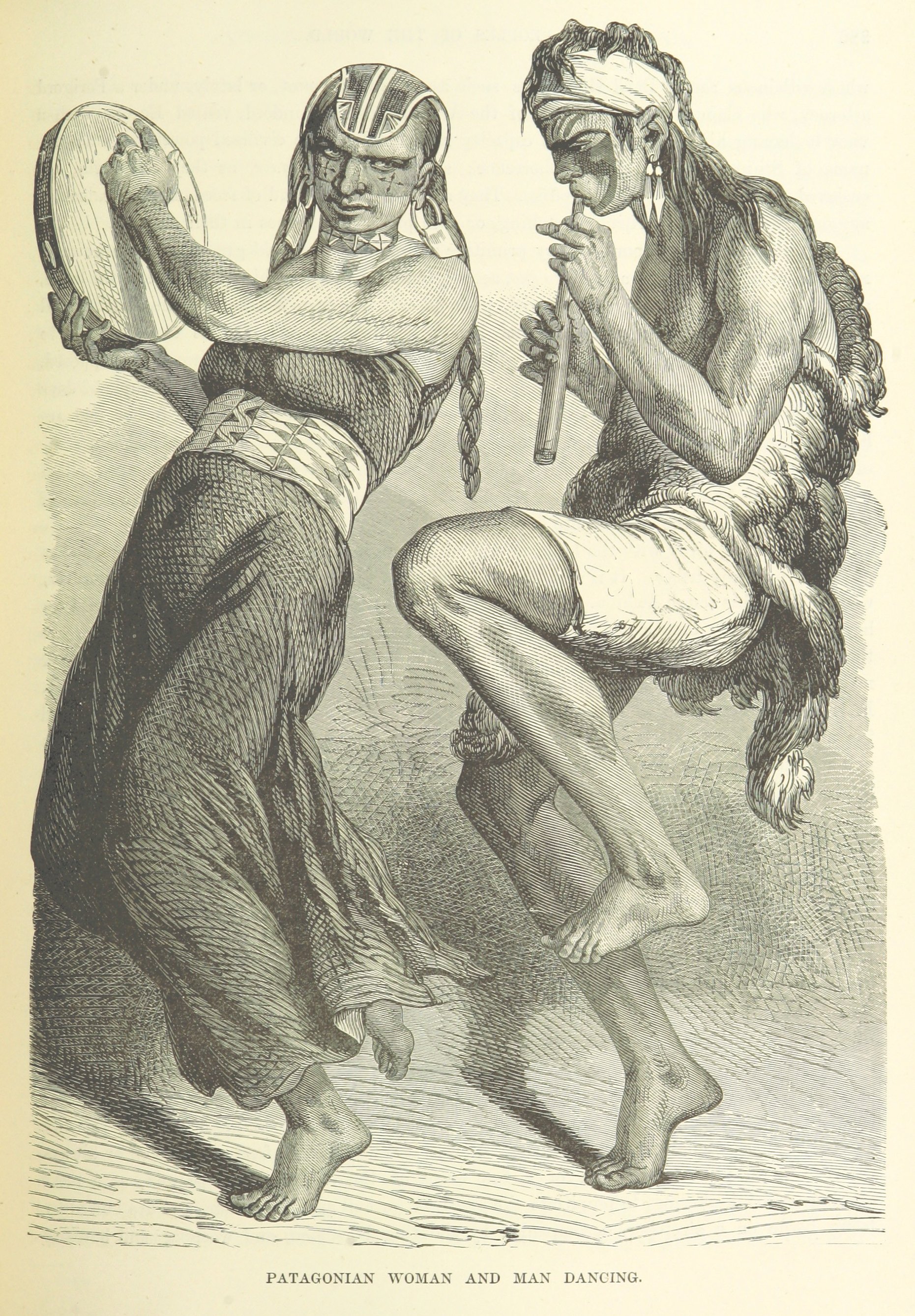
The dancer on the left is one of two "prophetesses" featured in the Crossroads suite (the other is in "Ostrischizocracy"). They are androgynous figures posed with blank books. There is an old tradition of soothsayers being androgynous. For example; the oracle of Apollo, "Tiresias", who spent seven years as a woman. Michelangelo depicts the "Sybille de Cummes" with pronouncedly masculine physique. Tehuelche Indians of Patagonia were recounted as giants by European explorers, perhaps giving this illustrator license to depict the woman with such masculine arms. Whatever the case, she slipped readily into her new role as prophetess astride an ichthyosuarus.
Patagonian Dancers, from the Collection of the British Library
Patagonian Dancer (2)
Armillary Sphere
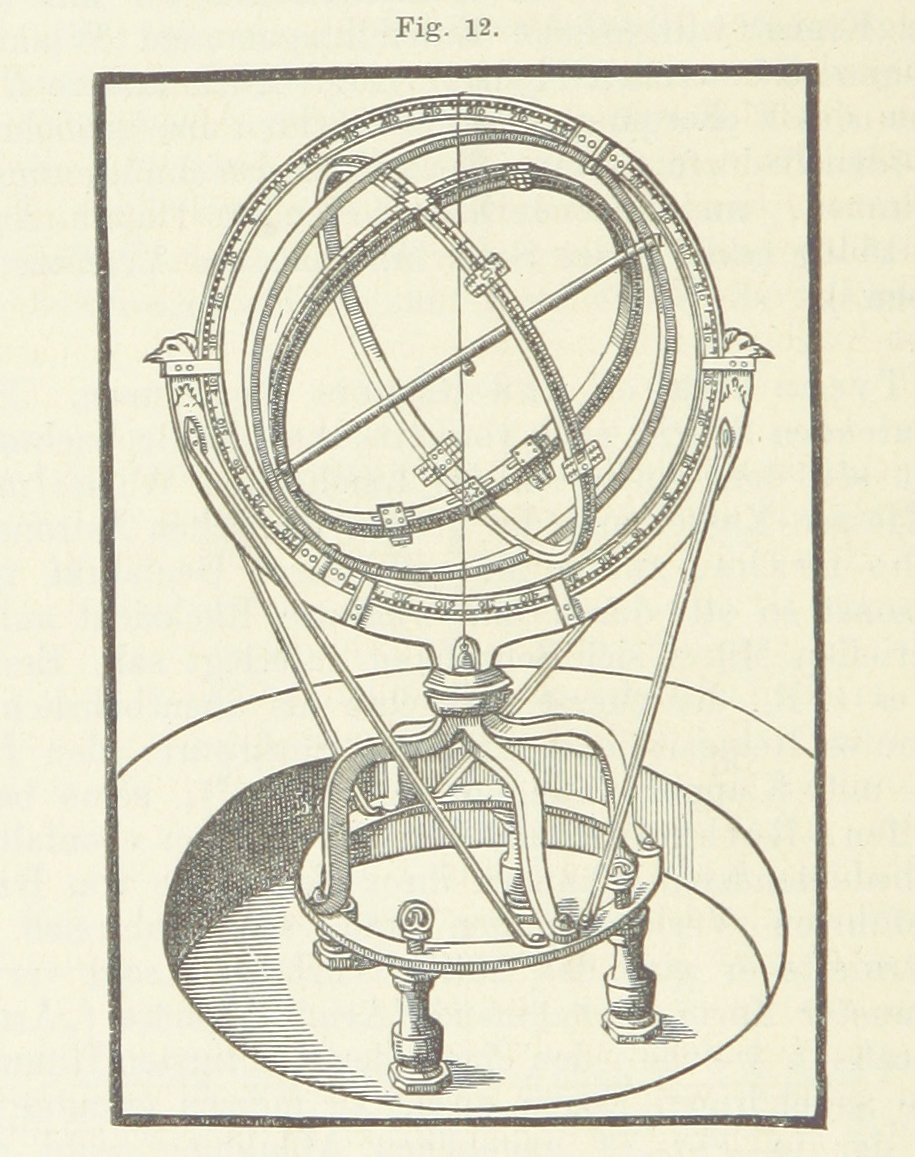
"Plesiosaurus is playing with the Armillary Sphere". Try speaking it yourself out loud. Don't you think there is something immensely satisfying about these words? No, not like that . . . you have a dirty mind!
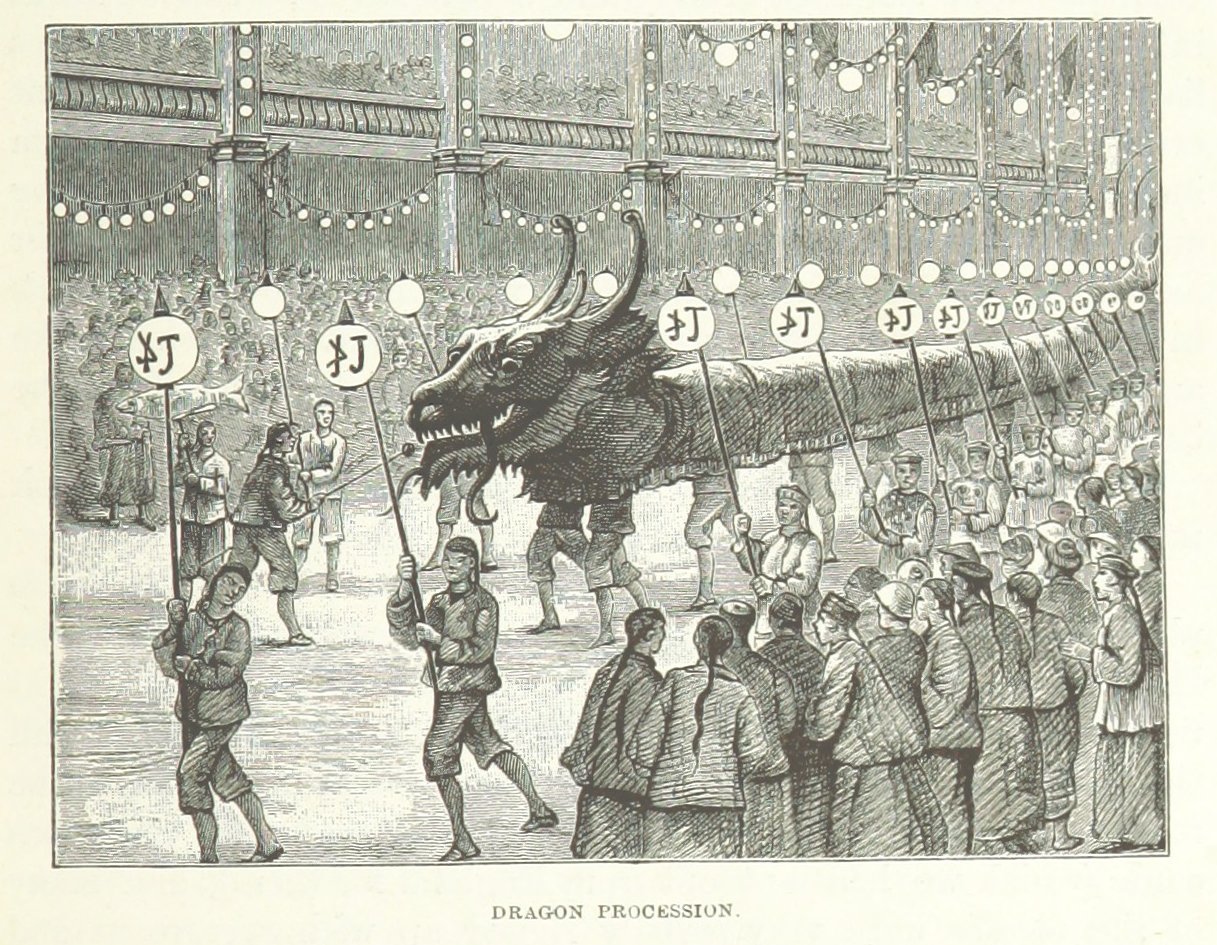
Perhaps "armillary sphere" is nice to say because it refers to the entire cosmos and the evolving human effort to understand it. The earliest Armillary spheres were made by the ancient Chinese. If you have seen a Chinese New Year parade than you may have noticed that the dragon always pursues a golden orb on the end of a baton wielded by a dancer who effectively leads the dance. This orb is meant to symbolize a pearl, and it is fitting that the drama of the painting revolves around the pursuit of this armillary sphere - a cosmic golden pearl - by the Chinese Dragon. As though the cosmos were a pearl of technology evolving from the prehistoric primordial sea to become a contest between East and West.
Armillary Sphere, from the Collection of the British Library
Armillary Sphere (2)
Pharos Of Alexandria
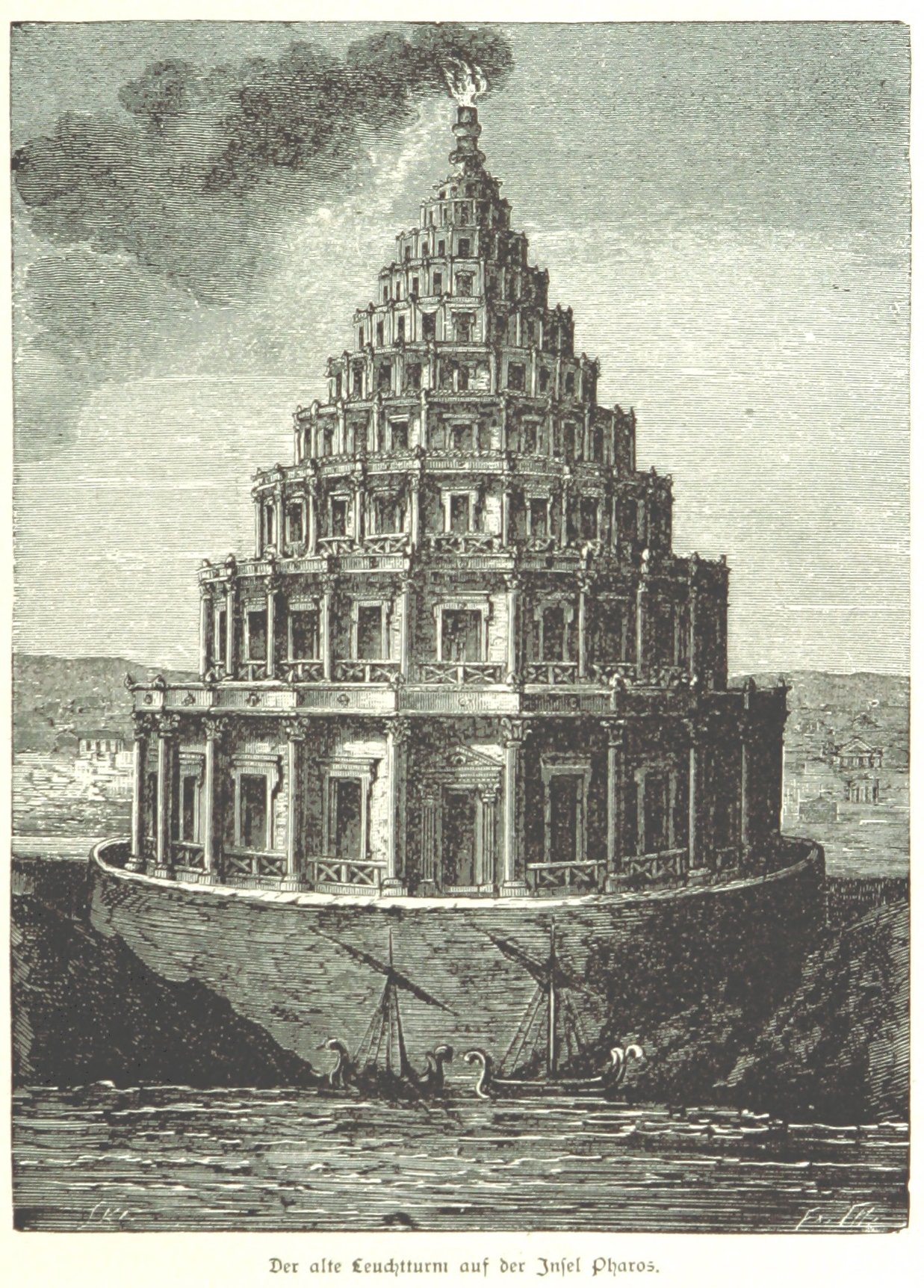
Pharos of Alexandria, one of the Seven Wonders of the ancient world, was for centuries one of the tallest man made structures. This illustration, reminiscent of Pieter Breughel's, "Tower of Babylom" lent itself easily to being transformed into a volcanic mountain erupting with an atavistic force as it releases a furious army of Maori warriors who dance their infamous war dance, the Haka, on clouds of fire.
Pharos of Alexandria, from the Collection of the British Library
Pharos Of Alexandria (2)
Chinese Dragon
The Chinese Dragon emerges (implausibly) from the arched gate of the Mosque, and a procession leads across the Royal Square of Ispahan to cross a railway bridge across the Firth of Tay, Scotland (one that collapsed tragically in 1879) that is dwarfed by the scale of this gigantic Dragon. To one side are crusaders, and to the other is the railroad. The Dragon, emblematic of Chinese tradition, is hemmed in on all sides by the forces of the West, and yet nimbly steps over it all to pursue something beyond comprehension.
Chinese Dragons, from the Collection of the British Library
Chinese Dragon (2)
Mummy
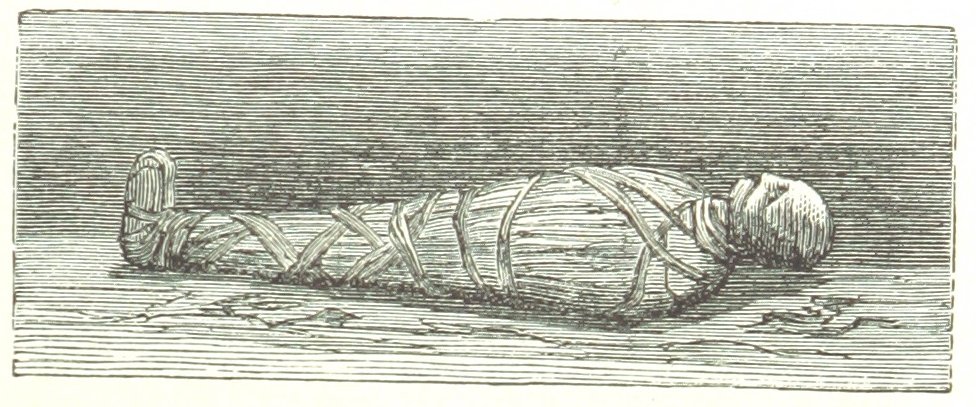
Here is a Mummy being born away by crusaders. Unwittingly they are upholding traditions of magic. Knights Templar marching off the canvas with their rare magical treasure which they will never fully understand, though its dust and its mysteries will slowly erode their Christian civilization. Actually, they are mistaken - it is not a mummy at all! It is a soap carving of a mummy - made from soap bars of "Lifebuoy" soap, and they have been duped, however crowds of schoolchildren in lofty museum halls will never be the wiser.
Mummy, from the Collection of the British Library
Mummy (2)
Koh I Noor
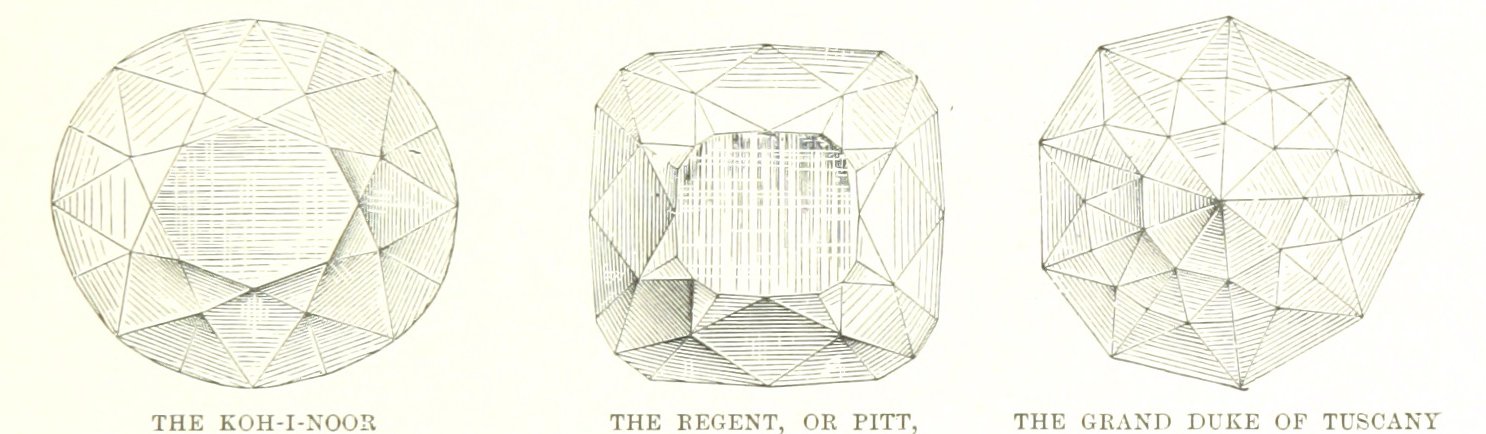
The Koh-i-Noor diamond gives a crystalline form to the great planetary orb that dominates the upper-right side of the composition. Centuries before the Koh-i-Noor was one of the British Crown Jewels, it was the left eye of the Hindu Goddess Bhadrakali in the temple devoted to her worship in Warangal, India. It is said that the Koh-i-Noor only sparkles when the light hits it just the right way, and one wonders if in that ancient Hindu temple a shaft of light from the rising sun on the Vernal Equinox might not have lit it in such a powerful way that the idol of the Goddess seemed to awake.
Koh-i-noor, from the Collection of the British Library
Koh I Noor (2)